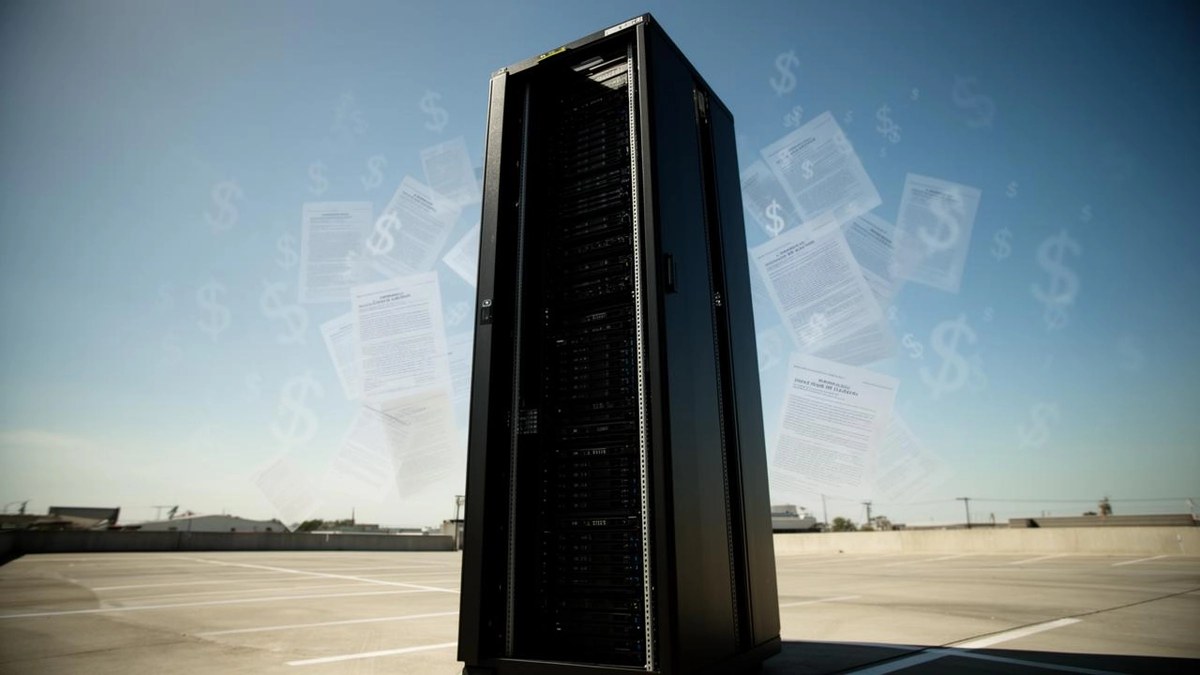
One number crystallizes the problem Edmund Reese is trying to solve. A single AI data center site now costs $20 billion to $50 billion to build. The entire global insurance industry — property, casualty, health, wealth, everything — is a $5 trillion business. When your fastest-growing asset class is measured in percentages of the industry's total capital base, the math stops working.
"It's not sufficient capital from traditional insurance," Reese, the chief financial officer of Aon, said flatly on Bloomberg Businessweek. "We're going to have to do the same thing for data centers here, or you're going to see companies have it on their own balance sheets, or go out and look to fund debt for it."
That warning — insurance either innovates or becomes irrelevant to the defining industrial project of this decade — captures Aon's core strategic bet. The firm is racing to channel institutional money from sovereign wealth funds and private equity firms into covering data center risk, replicating a model it already dominates in the catastrophe bond market. The stakes, measured in the trillions of dollars now flowing into AI infrastructure, could reshape who bears the risk of the digital economy.
The Trillion-Dollar Math Problem
The scale of data center construction has moved far beyond what anyone projected even a year ago. When Aon first sized the insurance opportunity around this build-out, the firm estimated total premium potential at $10 billion. Reese now calls that figure conservative.
"The infrastructure spend over the next three years will be at least $2 trillion," Reese said, citing some estimates that reach as high as $5 trillion to $7 trillion when ongoing operations are included. The 2026 spend alone, which earlier forecasts had pegged at roughly $800 billion, is now substantially higher.
The gap between what's being built and what the traditional insurance market can absorb is not a theoretical one. It forces hard decisions for every hyperscaler constructing billion-dollar campuses. Reese's view is unambiguous: either the industry creates vehicles for pension funds, sovereign wealth pools, and private equity to take slices of data center risk, or those risks migrate entirely off insurance balance sheets.
Aon's template is the catastrophe bond market it helped pioneer. "We already over half of that market," Reese noted, referring to insurance-linked securities that channel capital market investors into covering hurricane and earthquake risk. That market is growing at a teen rate. The data-center opportunity, Reese suggested, represents a "250 million opportunity" — a figure that appears to reference an initial tranche of alternative capital Aon aims to intermediate, analogous to the catastrophe-bond segment, though the ultimate addressable market is orders of magnitude larger.
"The only way that institutional investors will enter is if we can provide the data," Reese said. "We are giving them the data that helps them see they can get attractive yields off of that."
Why the Hyperscalers Keep Calling
What Aon actually sells — beyond the insurance product — is the engineering expertise to understand where risk concentrates and how to disperse it. Reese said the firm has advised on "over 30% of the data center builds in the US," with the next-largest markets in China and Germany. That footprint predates the current AI boom and gives Aon a proprietary data set no pure insurance broker can replicate.
When Carroll read a breaking Bloomberg terminal headline during the interview — Deep Seek is developing a one-gigawatt AI data center in Inner Mongolia, aiming to bring part online by late 2027 or early 2028 — Reese's immediate reaction mapped the three dimensions Aon covers: construction, energy, and dispersion. A gigawatt-scale facility in Inner Mongolia poses a fundamentally different risk profile than a campus in northern Virginia, and Aon's pitch is that it has the data to price both.
The construction business line tells the growth story in hard numbers. Reese disclosed that Aon has reported double-digit growth in construction for "the last five quarters," including the just-reported Q2 2026. That streak directly captures the data center build-out, though Reese was careful to note Aon is "not over-weighted to this" — growth is broad-based across its portfolio.
Once facilities are operational, the risk exposure shifts but does not diminish. "Our CEO likes to say you measure it in millions per minute in terms of operations," Reese said, describing the business-interruption scenario for a hyperscale facility. Aon's "data center lifecycle program" layers cyber attack coverage, weather-event protection, and general liability on top of construction risk, creating a recurring revenue stream that extends well beyond the build phase.
War, Angst, and the Risk Business
When Carroll asked directly whether geopolitical violence is good for Aon's business, Reese offered a response that was candid about the mechanics while refusing to celebrate the cause.
"Geopolitical violence creates demand because clients want to protect their assets, and they still want to be able to invest and grow," he said. "Complexity across the risks that our clients are facing is the biggest, biggest issue we're discussing with them."
That complexity manifests in layered exposures. A shipping disruption in the Red Sea cascades into supply chain interruptions. Political violence coverage intersects with terrorism policies. Energy constraints — particularly acute for data center operators — tie into construction risk and operational continuity. The corporate mood, Reese characterized, is "angst" mixed with an undiminished appetite for capital deployment. Aon's role is to help clients map the interdependencies and then match each category of risk with the appropriate pool of capital.
The reference materials confirm this pattern at scale. US core capital goods shipments — a proxy for actual business equipment installation — surged 1.9% in June, the largest monthly gain since late 2021. Alphabet, Meta, Microsoft, and Amazon collectively signaled up to $725 billion in AI-related capital expenditure for 2026. The investment is real, it is accelerating, and it is creating risk exposures that grow faster than the insurance industry's balance sheet.
The Energy Bind That Could Break the Model
A parallel development that Reese did not discuss at length — but that directly affects Aon's data-center thesis — is the mounting political pressure over who pays for the grid expansion this infrastructure requires. The White House recently secured nearly 200 corporate signatories to a "Ratepayer Protection Pledge" requiring data center operators to pay premium power rates and fund their own delivery infrastructure. PJM Interconnection, the largest US grid, saw its latest capacity auction clear at the $325 per-megawatt-day price cap; the uncapped price would have been roughly $555. Data centers alone accounted for $6.3 billion, or 38%, of the $16.4 billion in charges from that single auction.
For Aon, this energy-cost dynamic cuts both ways. Rising grid costs make operational risk more expensive to insure, which expands the role for alternative capital structures. But political backlash that results in moratoriums or project cancellations would shrink the universe of insurable assets. The reference materials note that Morningstar DBRS has already flagged state-level restrictions on data center growth as a potential "material credit factor" that could weaken project credit quality. Aon is betting that the economic imperative of AI infrastructure overwhelms the political objections. So far, the five-quarter growth streak suggests that bet is paying out.
A Stock Market Looking the Other Way
The macroeconomic backdrop to Reese's argument is a technology sector undergoing a sharp repricing. Global semiconductor stocks have suffered consecutive selloffs, with the Philadelphia Semiconductor Index down heavily and TSMC ADR falling below $400. Paul Markham, global equity head at GAM, warned that AI trades remain "overcrowded" and that "there are too many people standing on the same side."
Yet the physical infrastructure build continues to accelerate even as chip valuations compress. That divergence — financial markets pricing in skepticism about AI returns while companies pour trillions into concrete facilities — creates exactly the kind of risk dislocation Aon is positioned to intermediate. An $800-billion-plus annual construction spend does not pause because semiconductor stocks had a bad week. The facilities get built regardless, and someone has to insure them.
Reese offered no signal that Aon sees softening demand. The drivers — corporate AI investment, energy demand, the sheer volume of data center construction already in the pipeline — remain intact. "This is a tailwind for our growth as we move forward," he said.
The Insurance Industry's Existential Crossroads
Reese's core argument is that the insurance industry faces a structural choice it has not fully confronted. The catastrophe bond market proved that institutional capital will accept insurance risk when the data is transparent and the yields are attractive. That market took decades to build and now handles a meaningful fraction of global natural-disaster exposure. Data center risk is arriving at a speed that compresses that timeline.
The alternative is what Reese described explicitly: companies "have it on their own balance sheets, or go out and look to fund debt for it." For the hyperscalers — Amazon, Meta, Microsoft, Google — self-insuring trillion-dollar infrastructure portfolios is not inconceivable. Their balance sheets can absorb it. But a world in which the largest infrastructure build-out in a generation bypasses the insurance industry entirely is a world in which insurers have conceded their relevance to the most capital-intensive sector of the economy.
Aon's bet is that its data — the engineering models built across thousands of construction projects, the risk-dispersion analytics, the five-quarter growth streak in a line of business directly tied to data center activity — can attract institutional capital fast enough to make that scenario irrelevant. Whether sovereign wealth funds and pension pools accept the proposition will determine whether Reese's confidence proves prescient or whether the insurance industry's largest opportunity becomes its most conspicuous failure.
- AI Investment Boom Unstoppable: U.S. Core Capital Goods Shipments Post Biggest Gain in Over Four Years
- AI Arms Race Jitters Hit Nasdaq at Open; Heavy Selling Pressure on Philadelphia Semiconductor Index
- Trump Pushes Data Centers to Absorb AI Power Costs, Secures Backing From Nearly 200 Utilities
- A-Shares Open Sharply Lower, Led by Semiconductor and Computing Power Sectors; Nearly 3,800 Stocks Decline