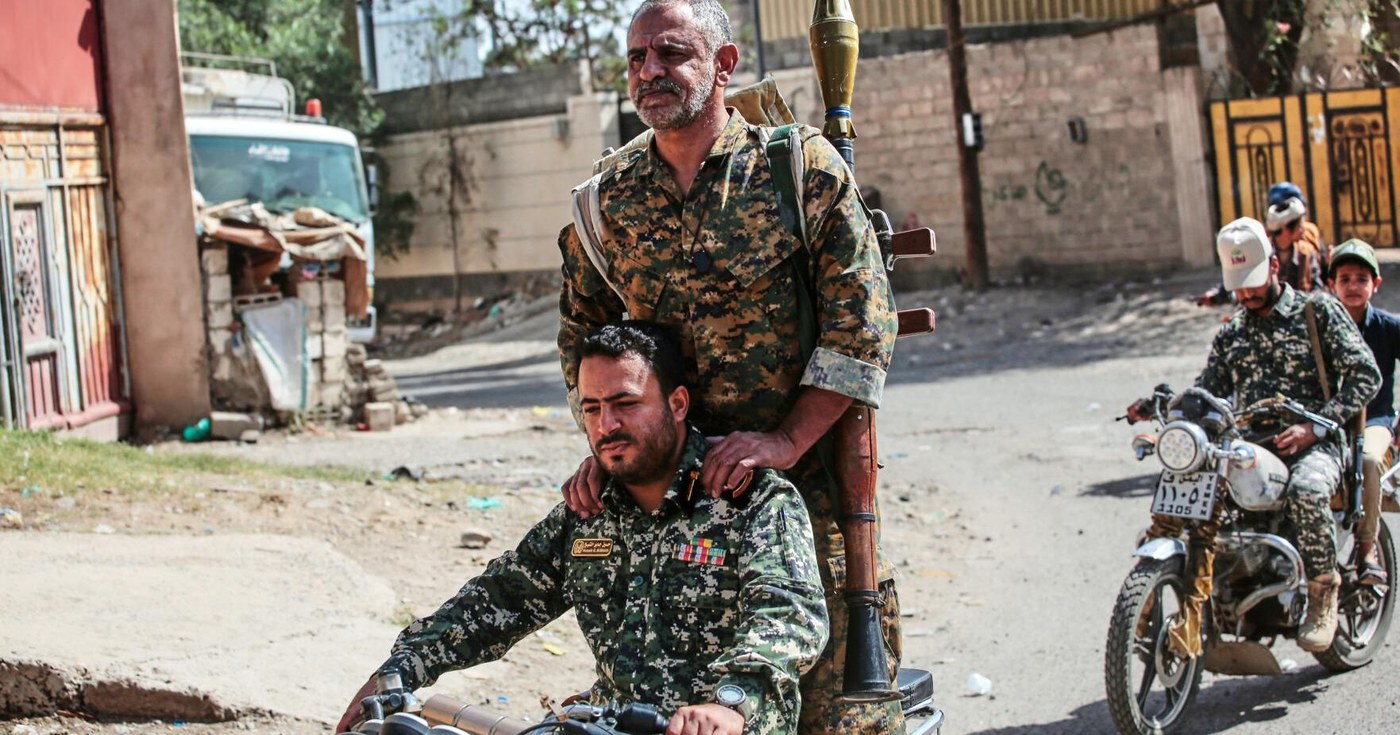
Houthi rebels effectively completed a rapid push to take control of Yemen’s Red Sea coastline on Friday, tightening their grip on one of the world’s most important shipping routes and delivering a dramatic boost to their backers in Iran.
At the same time, strikes inside Saudi Arabia forced the shutdown of a critical oil pipeline, the country’s energy ministry confirmed Friday.
Saudi Arabia said drones launched from Iraq attacked its East-West pipeline, but said it would not retaliate for now following a request from Iraq’s prime minister, while reserving the right to take all necessary measures to protect its sovereignty, security and critical facilities, according to a Saudi foreign ministry statement.
An Iraqi military commander was dismissed early on Saturday after investigations confirmed the latest drone attacks targeting Saudi Arabia originated from Iraq, according to a statement by Iraq‘s prime minister’s office.
Houthi forces captured Perim, an island in the middle of the vital Bab el Mandeb Strait, several news agencies reported, citing multiple sources. A day earlier, the Houthis captured the historic port city of Mocha.
That was followed by an advance on the strategic coastal town of Dhubab and the apparent withdrawal of forces from the Saudi-backed, internationally recognized Yemeni government, from Perim, also known as Mayun.
The U.S. military is helping its Saudi counterparts to develop and coordinate targets inside Yemen, according to a U.S. official and a person familiar with the matter, after Saudi Arabia vowed a firm response to hostilities.
The Houthis and the opposing coalition have been fighting a civil war since 2014. The conflict has simmered for years but erupted into intense fighting again in recent weeks, raising concerns of a return to all-out war and posing a serious new threat to the global economy.
Effective Houthi control over Bab el Mandeb, a gateway to the Red Sea trade route that links Europe and Asia, could further imperil oil exports while granting Iran powerful new leverage in its war with the United States.
Saudi Arabia, the world’s biggest oil exporter, has had to rely on the Red Sea route given the disruption to the Strait of Hormuz, through which some 20% of the world’s oil used to pass, since the U.S. and Israel waged war on the Islamic Republic in late February.
If the Houthis are similarly able to threaten shipping along the Bab el Mandeb Strait, it could reduce oil supplies through another key waterway and deepen the world’s energy crisis.
Saudi Crown Prince Mohammad bin Salman is urging President Donald Trump to take military action against the Houthis, according to a person familiar with the matter.
The president and the Crown Prince have discussed the recent escalation by the Houthis at least twice in the last 24 hours, this person said.
So far, Trump has declined to conduct military strikes against the Houthis, but has agreed to provide military assistance, such as helping the Saudis to develop targeting and sharing of information, the person familiar with the matter and a U.S. official said.
The discussions between President Trump and the Saudi Crown Prince were first reported by Axios.
The Houthis have recently attacked oil facilities in Saudi Arabia but on Friday the Saudi Foreign Ministry said in a statement that the drones targeting the East-West pipeline had originated from Iraq.
The Saudi Energy Ministry confirmed Friday that it had shut down the kingdom’s East-West oil pipeline after “multiple attacks.” This has been a key alternative for Saudi exports that can’t transit the Strait of Hormuz.
The ministry’s statement said the pipeline was “shut down as a precautionary measure,” but satellite imagery on Friday showed a 60-mile smoke plume along its route, while fire detection data showed high-temperature readings at several sites where infrastructure for the underground pipeline is located.
The Saudi Energy Ministry said the attacks “resulted in a number of injuries,” adding that its teams were “taking the necessary measures to secure the pipeline and assess its safety.”
Global oil prices appeared set to end the week above $100 a barrel for the first time since mid-May, after the dramatic developments.
Andreas Krieg, a senior lecturer at King’s College London’s School of Security Studies, warned that the risk of the conflict deepening had “increased substantially.”
“The important change is that the Houthis are now attacking both pillars of Saudi security simultaneously: southern Saudi territory and the Kingdom’s Red Sea strategic depth,” he said in written comments before the Houthis’ reported capture of Perim. “Riyadh still desperately wants to avoid another 2015-style war. But its room for restraint is narrowing,” he said.
A statement issued by Houthi forces on Friday said that “maritime navigation is safe for all companies except for Saudi vessels,” vowing to strike Saudi targets “until the aggression stops and the blockade against our dear people is lifted.”
The statement said that nine aircraft had been shot down by Houthi forces, with hundreds of opposing troops “killed, captured or wounded” in the rapid advance, and a number of prisoners “liberated.”
Krieg emphasized that while the Houthis appeared to be taking swift control of the Red Sea coastline in Yemen, the idea that they might gain “full control” of Bab el Mandab should be approached “cautiously.”
“Even control of Mokha, Dhubab and Perim would not give the Houthis sovereign control of the entire strait because the western littoral remains outside Yemen,” he said. “It would, however, give them a dramatically stronger ability to contest, threaten and potentially deny commercial use of the waterway.”
The result, he said, would “constitute an extraordinary shock to the global trading system.”
Amr al-Bidh, from the Southern Transitional Council (STC), a political and military group in Yemen, blamed this in part on the Saudi-backed government forces’ focus on pushing back STC from areas it expanded its control to last year. The STC and Saudi-backed forces had been fighting the Houthis together in the country’s north, but that coalition descended into infighting.
“We are also concerned about the situation because they might come to the south, and we have to defend the south from them,” he said in a video interview Friday.
The growing crisis was “not just about oil,” he said. “It’s about families who are displaced and moving from one place because of because of this war.”
The United Nations’ International Organization for Migration warned on Friday at least 46,000 people have so far been displaced in Yemen since fighting escalated last week.
It said that figure spanned the West Coast and Taiz governorates as of Thursday, with the numbers of those displaced “alarmingly rising by the hour.”
The organization called on all parties to the conflict to “guarantee safe humanitarian access and to protect civilians, aid workers and assets on the ground.”