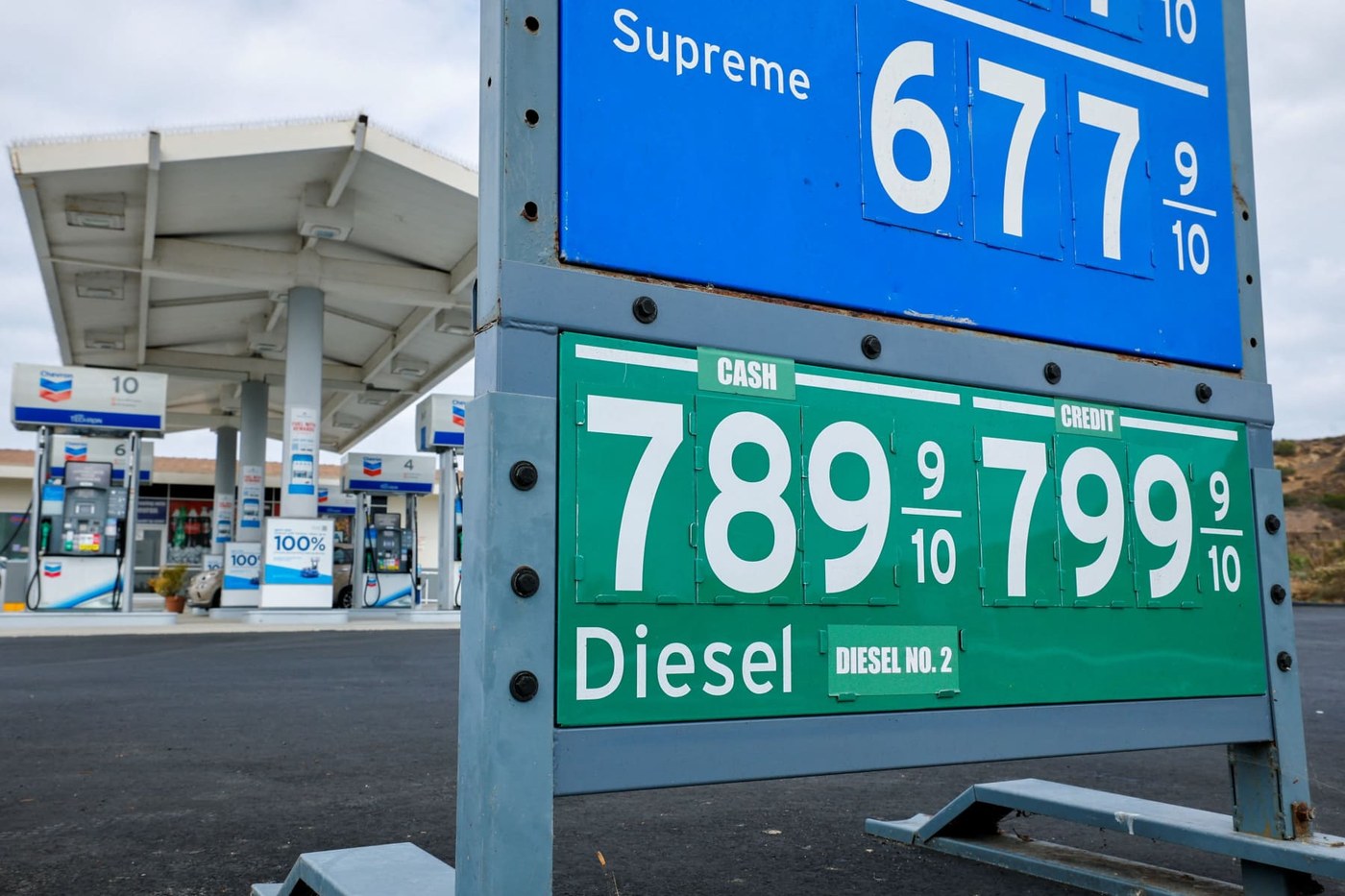
Ever since the outbreak of war with Iran earlier this year, motorists have been warily eyeing prices at the pump. While unleaded gas prices have largely avoided historic highs, the same can't be said for diesel fuel, which hit an all-time high of $6.31 per gallon on Wednesday.
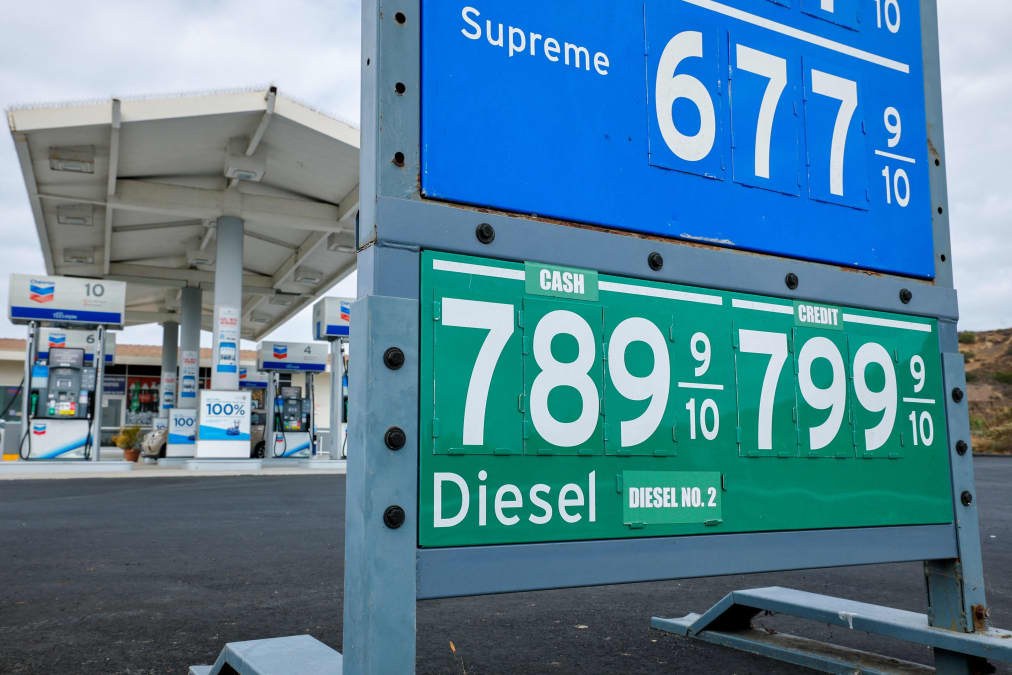
That was just the latest grim milestone in what has been a steady march upward. Economists and supply chain experts say what starts in the transportation sector, where trucking and rail companies are feeling the pain now — will eventually push prices on virtually everything in the economy up.
This is not surprising, because diesel is the economy's single most universal tangible input, said David Russell, global head of market strategy at TradeStation Group.
The first to feel it are freight haulers, but there will be plenty of other losers — consumers and companies — if diesel remains at record price levels.
The chief commercial officer for Norfolk Southern railroad noted at a Morgan Stanley conference on Tuesday that in California, the price of diesel was already $8.
Consumers are getting a taste of what could come next in the form of already higher prices at the gas pump. What is driving up gas prices right now isn't just the price of oil, said Jeff Lenard, vice president of media and strategic communications at the National Association of Convenience Stores. It's the price of diesel. The cost to get the gas to the gas station is the driving factor behind the steady increase at the pump.
"The higher transit costs are adding several additional cents to the cost of selling fuel – as do swipe fees that are percentage based and increase as prices increase," Lenard said. Retailers are faced with the tough decision of whether to absorb these added increases or pass them along at the pump.
"Right now, they are absorbing the bulk of the costs, which typically happens when wholesale prices and costs increase dramatically. Right now, retail gross margins have constricted by about 15 cents a gallon, which is typically what their net margin is," Lenard said.
And then the chips, soda, and doughnuts inside your favorite convenience store also have to get there — by diesel-powered trucks — so the pain from the pump seeps into the store because getting the items there is costing a lot more.
Costco recently made the decision to limit how much gas its members can buy.
Carmit Glik, CEO of Ship4wd, an all-in-one digital freight forwarder and subsidiary of Israeli shipping giant ZIM, said that diesel is the price nobody watches until it's already inside everything else. "It moves through freight rates, farm equipment, food delivery, and home heating, anything that touches a truck at some point in its journey," Glik said.
It can take awhile for the diesel cost to work its way through the economy and into your bank account.
"Consumers feel it last but not least," Glik said. "It shows up in grocery prices, delivery fees, and anything seasonal that depends on trucking to move fast, usually a few weeks after the spike, once surcharges work their way through the supply chain. That's different from gas, where drivers see the pain immediately at the pump," Glik added.
Truckers are the most immediately impacted, especially because many independent operators can't adjust quickly when costs rise. "Smaller players might get pushed to the sidelines, removing capacity and pushing shipping costs even higher. It's not a linear process," Russell said.
But if you are planning a trip this winter, you may pay more for it.
"Travelers face higher costs for holiday airfares because jet fuel is similar to diesel," Russell said.
"Higher diesel prices will spread across the economy, with consumers facing higher costs for ordinary goods delivered by trucks and services like home improvement," he added, noting the last PPI report showed pressure in a broad array of items from packaging to circuit boards.
"The list of impacted goods and services will only grow the longer diesel stays high," Russell said.
Heating oil costs this winter could surge
Home heating oil, used extensively in the Northeast to heat homes, tracks closely with diesel prices since they are made from the same ingredients.
Mark Wolfe, executive director of the National Energy Assistance Directors Association, said that home heating oil customers can expect to pay as much as 31% more this winter if prices stay at current levels.
But he said that is not the whole story. "Families are going to get hit three ways: heating oil, and then everyone will get hit with high gas prices, and delivery on everything is dependent on diesel, so regular, everyday families will really struggle," Wolfe said.
Wolfe's organization has been lobbying Congress to appropriate more funding for federal heat assistance programs, but with the chamber in recess until November that looks unlikely, he said.
"Unless the states step in there will be significant hardship for low income and even middle class. It has gotten expensive enough that families will not be able to afford fuel without significant sacrifices," Wolfe said.
One possible saving grace could be this season's Super El Nino which has the National Weather Service predicting well above normal seasonal temperatures for the Northeast.
Steve Blough, chief supply chain strategist at Infios, a supply chain software provider, thinks the price still has higher to climb.
"Many factors are affecting the price. The reduction in refining capacity in the Gulf states combined with the Ukraine war shutting down much of the Russian production and then the attack on the Saudi pipeline are making for a perfect storm," Blough said.
He said any other unforeseen disruptions, such as a late-season hurricane or another geopolitical event, could force things higher, though many experts are hesitant to make firm forecasts about additional increases given the volatility in the market and geopolitics.
Saudi Arabia is taking measures to get more oil to the market, which sent crude prices lower on Thursday.
Why diesel prices are so high, and why it will be hard to lower them
Jack Buffington, associate professor in supply chain management at the University of Denver, said that while oil prices have largely been held in check, diesel prices are exploding not because of the rise in crude oil prices as supply has been pressured but due to a lack of global refining capacity.
"Oil distribution has been a problem with the shutdowns in the Persian Gulf and Red Sea, but not as significant as the losses in refining capacity in Russia and the Middle East, Russia especially," Buffington said, noting that nearly 100% of the world's available refining capacity is currently being utilized.
"It doesn't mean that 100% of the world's capacity is being utilized, but rather 100% of what isn't damaged. So perhaps 20% of the world's capacity is offline, which is the bottleneck," Buffington said. But even if conflicts around the world stopped today, prices would not start sinking significantly.
"Some believe, incorrectly, that once the kinetic fighting stops that diesel prices will fall, but that's not the case due to net refining capacity," Buffington said, adding it could take a year or longer for prices to return to the $4 level.
The biggest losers right now are truckload carriers, especially small firms or owner-operators. "Large carriers tend to protect themselves somewhat better with fuel surcharge programs," Blough said. Shippers that don't have fuel protection in their contracts — manufacturers, retailers and distributors — also ultimately pay more when carriers increase rates or fuel surcharges.
But big trucking companies are not immune from the pain. Trucking giant J.B. Hunt CFO Brad Delco said the company has seen "some of the most radical and abnormal swings" in fuel prices that it has ever seen and record-high diesel prices, which are causing at least a $10 million headwind. The company warned of lower earnings to come because of the diesel headwinds.
Blough said farmers will be clocked by the high prices because of the high use of diesel to transport fertilizers and crops and operate tractors and combines. "Those costs can be hard to pass on," Blough said. That has already become a big midterm elections headwind for Republicans in farm states.
Construction, public transit, and food distribution are all poised to be clobbered by higher prices. Construction is especially exposed because the machinery that consumes heavy commodities like cement and gravel is all diesel driven. "They could also get squeezed as they need to complete work at contracted prices," Russell said.
Blough said transportation companies will do what they can to adapt — reassessing routes, carriers, modes, inventory and delivery priorities, because when diesel becomes this expensive, "every mile matters."
"Simply absorbing the higher cost," he said, is not a winning business strategy.
Glik said there will be a few winners in this diesel surge. One is refiners with strong distillate margins that benefit from a wider crack spread — the difference between crude oil prices and wholesale petroleum-product prices.
Another is larger carriers who lock in fuel at wholesale while billing surcharges at retail can see a real margin gain.
"That's a structural advantage smaller carriers don't have, and a big shipper can wait out a fuel spike in a way a small business owner can't. They have to decide today whether to eat the cost or pass it to their customer," Glik said.
Railroads might get more business because they are cheaper than trucks, but they also stand to lose business if the economy slows at a broader level.
Federal Reserve Chair Kevin Warsh referenced the crack spread in his post FOMC meeting press conference on Wednesday as a contributing factor to inflation and the Fed's decision to raise interest rates as the best way to bring price stability back to the U.S. economy on behalf of stressed consumers.
"It is not simply spot prices of energy, or spot prices for corn or soybeans or wheat, but it is the difference between those spot prices and so-called crack spreads," Warsh said. "What that means for products that find their way into a store across the country."
For diesel prices headed into this winter, much depends on how long the Strait of Hormuz disruption and the Russian refinery issues persist. U.S. refinery utilization is already near max, so there's limited slack left to absorb another supply shock. Russell said any expert claiming certainty on this right now is guessing, but the glass is more likely half empty. "We face a lose-lose scenario in most cases," Russell said.
—CNBC's Alex Harring contributed to this report