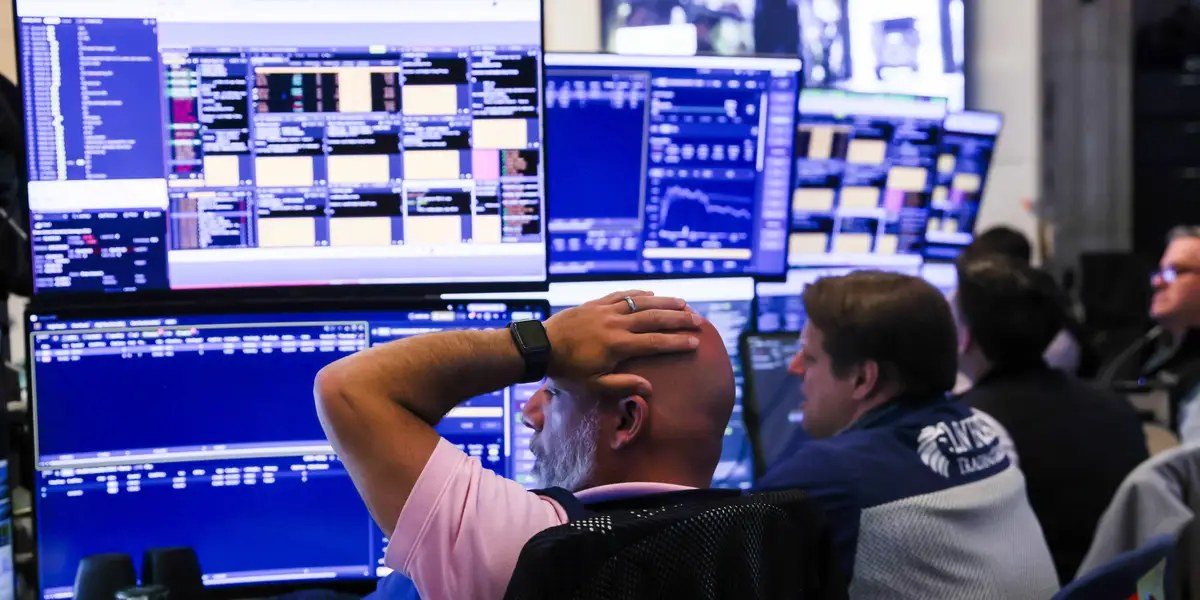
Semiconductor stocks have been hit by large-scale sell-offs, with investors questioning the sustainability of the AI-driven rally. The Korea Composite Stock Price Index (Kospi) saw an intraday drop of over 7%, dragging down regional markets across the board. Meanwhile, oil prices turned lower after early gains.
In pre-market US trading, memory chip stocks fell broadly, with SK Hynix down about 5%, SanDisk down about 4%, Western Digital down about 4%, and Seagate Technology down about 3%. TSMC dropped nearly 5% after releasing its second-quarter earnings report. The Nasdaq 100 futures extended losses to 0.6%, hitting a new low for the day. The Korea Composite Index closed down 6.4% after an intraday loss of up to 7.6%, triggering a circuit breaker. SK Hynix closed down 12%. The Nikkei 225 ended down 2.8% at 66,835.54 points.
Brent crude was boosted earlier by a new round of US airstrikes on Iran, but then reversed to trade down 0.5% at $84.50 per barrel, ending a three-day streak of gains.
Bloomberg strategist Garfield Reynolds noted: "South Korea’s stock market, a leader in the global equity rally this year, is now sliding for several consecutive sessions, raising concerns that this benchmark may lead its peers lower globally."
- Nasdaq 100 futures extended losses to 0.6%, hitting a new daily low. In pre-market US trading, memory chip stocks fell broadly, with SK Hynix down about 5%, SanDisk down about 4%, Western Digital down about 4%, and Seagate Technology down about 3%. TSMC dropped nearly 5% after releasing its Q2 results.
- Euro Stoxx 50 opened up 0.3%, Germany’s DAX gained 0.1%, UK FTSE 100 fell 0.5%, and France’s CAC 40 was flat. Stoxx 600 extended losses to 0.5%.
- Nikkei 225 closed down 2.8% at 66,835.54. TOPIX closed down 1.5% at 4,028.79. Korea’s Composite Index closed down 6.4% at 6,820.21.
- US stock index futures rose slightly by 0.1%.
- The yen was little changed at 162.11 per dollar.
- Japan’s 10-year yield added 1 basis point to 2.695%.
- Spot gold fell 0.6% to $4,034.52 per ounce.
- Brent crude fell 0.5% to $84.50 per barrel, ending a three-day streak of gains.
- Bitcoin fell 0.6% to $64,561.89.
One of the triggers for this round of sell-offs was the significant volatility sparked by domestic leveraged ETF products in Korea. These ETFs, which are linked to stocks like Samsung Electronics and SK Hynix, were listed just two months ago and use 2x leverage to amplify daily returns and losses. Their daily rebalancing is widely blamed by market participants for increasing price swings.
In response, the Chairman of Korea’s Financial Services Commission stated that authorities would soon announce regulatory measures for these leveraged ETFs. This statement highlights growing regulatory concerns over overheating in the market.
John Woods, Chief Investment Officer and Head of Investment Solutions for Asia at Lombard Odier, told Bloomberg TV: "I have long been worried about this speculative mania among Korean retail investors. Whenever I see any market with excessive leverage, I get concerned. It usually doesn’t end well, according to experience."
This correction comes after a surge in tech stocks. The Korea Composite Index has risen over 60% year-to-date, raising market questions on whether high valuations in the semiconductor sector can withstand earnings season. The Asia chip stock index fell 3.1% overall, approaching a new one-month low.
Suresh Tantia, APAC strategist and Chief Investment Officer at UBS Global Wealth Management, offered a more optimistic view on Bloomberg TV: "After a 100% rally, it’s quite natural to see consolidation and profit-taking—this is what we’re now seeing in Korea. We remain bullish on Korean equities and view this as mid-cycle digestion." Meanwhile, Nvidia co-founder Jensen Huang emphasized that the company’s new generation AI accelerator system has entered mass production and deliveries are proceeding as scheduled.
Macroscopically, US June producer price inflation data came in below expectations, pushing US Treasury yields lower. Australian and New Zealand government bond yields tracked the move higher. The US dollar index steadied after falling the past two days, with markets widely betting that the Fed faces limited rate hike pressure. Gold fell 0.6% to about $4,035 per ounce, ending a two-day rally.
The oil market was rattled by Middle East tensions. US airstrikes on Iran boosted oil prices early on, but the gains did not last. David Russell from TradeStation said: "Energy played a supportive role in June, but if the Strait of Hormuz doesn’t reopen soon, that tailwind could quickly become history." Concerns about energy supply disruptions are offsetting the optimism from weaker inflation data, keeping investor sentiment generally cautious.
US June Producer Price Index (PPI) came in below expectations on Wednesday, pushing US bond prices higher and leading traders to further reduce their expectations for Fed rate hikes this year. Australia’s and New Zealand’s government bonds followed US Treasuries higher. The US two-year Treasury yield retreated further from its 2026 highs.